Responsible AI Is an Operating Model, Not a Policy
Responsible AI depends on connecting principles to enforceable controls, named accountability, and evidence of actual behavior. Those connections must shape workflow design, delivery, and ongoing operation—not end with a policy or launch approval.
An organization can have an AI policy, a review committee, and a clear statement of ethical principles while remaining unable to answer a practical question: who can stop a deployed system when its behavior becomes unacceptable?
The gap may become visible only after release. A customer challenges an outcome, a permission exposes information to the wrong audience, or a model update changes how requests are handled. The policy describes the desired behavior. The people responding need authority, evidence, and a workable means of correction.
Policies are necessary. They establish commitments, define prohibited uses, and provide a basis for consistent decisions. Their effect depends on how those commitments are translated into the work. A statement about fairness cannot determine whether a particular workflow disadvantages some users. A requirement for oversight cannot give a reviewer the information or time needed to intervene meaningfully.
Normatic's position is that responsible AI must be an operating capability. Responsibility becomes real through the choices an organization makes about purpose, system behavior, authority, evidence, and continuing operation. This extends our earlier argument that the AI operating model cannot be delegated to an AI department. It cannot be delegated entirely to a governance team either.
The test is whether the organization can connect what it promises to what its systems actually do, and respond when the two diverge.
Principles need controls, owners, and evidence
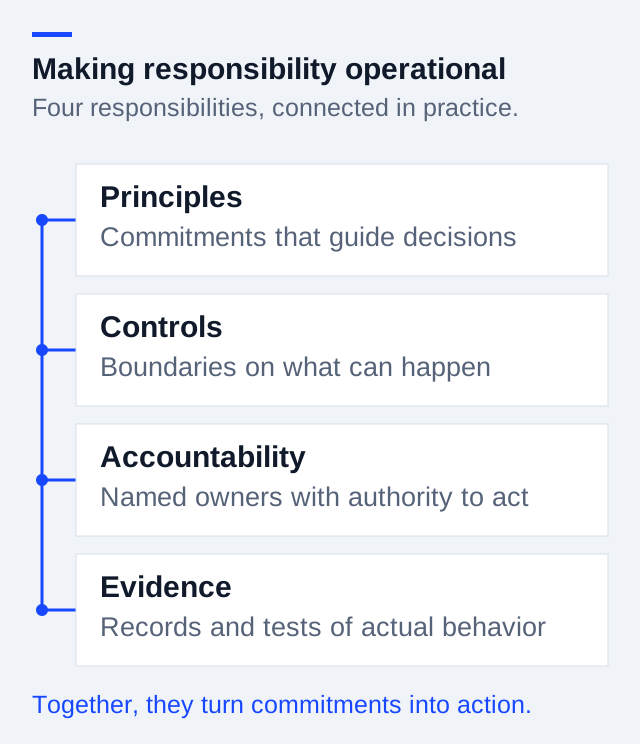
Four elements make that connection usable. Principles state the commitments that should guide decisions. Controls shape what the system and its users can do. Accountability assigns responsibility for choosing, operating, and changing those arrangements. Evidence makes it possible to assess whether they work.
Consider an illustrative system that classifies customer complaints and directs them to service teams. A principle might require people to receive appropriate treatment regardless of how they express their concern. That commitment needs to affect the definition of urgency, the evidence considered, and the handling of uncertainty. Otherwise, polished language or an easily recognized complaint category could receive more attention than a poorly expressed but serious problem.
Controls could limit the system to routing and summarization, prevent it from closing unresolved complaints, and require review when relevant evidence conflicts. A business owner would remain responsible for the service outcome, while technical owners maintain the routing, access, and monitoring mechanisms. Evaluation and operating records would show which cases were delayed, reassigned, or incorrectly treated as resolved.
The four elements have different roles. A control without an owner can deteriorate unnoticed. An accountable person without authority cannot correct it. A record without a review process can document a problem without changing anything. A principle provides direction, but the connections determine its practical force.
NIST's AI Risk Management Framework 1.0 provides a relevant foundation. It organizes risk management around Govern, Map, Measure, and Manage, with governance extending across the other functions and the system lifecycle. It is voluntary guidance, rather than a law or evidence that a particular implementation is effective. Its structure supports treating governance as part of ongoing work. NIST AI RMF Core
The executive decision is therefore larger than adopting a framework. It includes providing the resources and authority needed to apply commitments to specific systems and their consequences.
Responsibility begins with what the workflow is trying to achieve
Responsible design starts before model selection. The purpose of the workflow determines whose interests count, which outcomes matter, and what trade-offs the system may make.
In the complaints example, optimizing the number of cases marked complete could reward a different behavior from resolving the underlying problems. A system can perform its assigned task accurately while contributing to an undesirable outcome if the objective is poorly chosen. Better model accuracy would not resolve that design error.
The people affected by the workflow can also reveal consequences that delivery teams do not initially see. Customers may find it difficult to correct an inaccurate summary. Employees may discover that an automated priority label is treated as final even when it was intended as advice. Those observations should influence the design and acceptance criteria, rather than being treated only as feedback on usability.
The design must make clear which decisions belong to AI, conventional software, or people. It should establish permitted information use, action boundaries, routes for uncertainty, and a way to correct mistakes. Some proposed uses may need to be narrowed or deferred when their consequences cannot be adequately understood or controlled. That is a substantive design decision, not a failure to adopt AI.
The OECD's 2026 Due Diligence Guidance for Responsible AI reinforces the importance of impacts beyond the deploying organization. It connects policies and management systems with identifying and addressing adverse impacts, tracking results, communicating action, and providing or cooperating in remediation where appropriate. These are governance recommendations, not a universal compliance checklist. OECD Due Diligence Guidance for Responsible AI
For Normatic, the implication is that responsibility must include what happens to the person affected. Improving internal efficiency while making an incorrect outcome harder to challenge would be an incomplete account of success.
Accountability must cross functions without becoming ambiguous
Responsible AI requires several kinds of expertise, but a list of participating functions does not establish who can decide or act.
Executive leadership sets priorities and resolves material conflicts between expected benefit and exposure. Business owners remain responsible for the intended outcome and the way the workflow affects people. Product teams translate those expectations into requirements and acceptance decisions. Engineering implements and tests the system's behavior, while data and security teams address information quality, access, and protection. Legal, compliance, and risk specialists determine the requirements and challenge appropriate to the use. Operations maintains the capability after launch.
The important boundaries are the decisions between those responsibilities. Someone must determine whether unresolved evaluation findings prevent release, who can approve a constrained trial, and who can suspend a capability when a serious problem appears. The necessary authority should be assigned before a disagreement or incident makes it urgent.
A central responsible-AI function can provide methods, specialist advice, review, and independent challenge. It should have a clear mandate to raise concerns and a route to leadership when those concerns are not resolved. That role complements delivery ownership. It does not absorb every business, engineering, or operating obligation.
These arrangements need funding and incentives. A process owner charged with monitoring harm needs access to evidence and people able to investigate. A team asked to delay release when controls are inadequate should not be measured solely on launch speed. Formal accountability becomes weak when the organization rewards the behavior that undermines it.
External providers add another boundary. A vendor may operate the underlying model, but the adopting organization still chooses the workflow, access arrangements, and consequences of use. It needs sufficient information and contractual arrangements to manage that dependency, including changes and incidents. Accountability cannot end at the procurement decision.
Oversight should change with the consequences
Human judgment remains essential, but requiring a person to inspect every output is not a complete responsible-AI strategy. Oversight must be designed around the consequences of the action, uncertainty, reversibility, sensitivity, applicable obligations, and demonstrated reliability.
An internal document label that can be readily corrected may justify a different arrangement from a decision affecting a person's employment, access to credit, healthcare, or public services. Those decisions also differ among themselves. The relevant protections depend on the particular use and its requirements, rather than on the presence of AI alone.
In the complaints workflow, automatic routing may be appropriate within evaluated boundaries. Rejecting a complaint or making a consequential commitment presents a different question. The system's authority should reflect that distinction, even when the same model can generate both outputs.
Meaningful review requires the evidence behind the proposed decision, visibility of uncertainty, and a practical ability to challenge or stop the action. A reviewer who sees only a polished recommendation may have little opportunity to identify its missing assumptions. A reviewer whose queue is unmanageable may become a source of nominal approval rather than considered judgment.
Controls must also work when the system fails to recognize its own uncertainty. Monitoring completed actions and reviewing appropriate samples can reveal problems that never reached the exception queue. As discussed in The Future Organization Runs on Exceptions, a functioning escalation path matters, but it cannot be the only source of assurance.
Proportionate oversight is therefore a design choice supported by evidence. Its purpose is to make human authority effective where required, while allowing suitable work to proceed within established limits.
Privacy and transparency depend on architecture
A privacy commitment must survive the information's actual path through the workflow. A request can move through a prompt, a retrieval service, an external model, an application log, and an output sent to another person. Controls applied only at the original database may not cover all of those uses.
The organization needs to establish what data the task requires, whether that use is appropriate for its purpose, where the information moves, who can access it, and how long it is retained. Sensitive material should not be included simply because it is available. Permissions and purpose restrictions need to be reflected in the surrounding systems, including access to logs and retained conversation history.
The distinction between reading and disclosing information is particularly important. A service employee may be authorized to consult internal notes without being authorized to reproduce them in a customer response. A system that respects the employee's access rights can still produce an inappropriate disclosure if the audience and intended use are ignored.
Transparency likewise needs a practical purpose. An operator may need to know which system version acted, which records it used, what action occurred, and who approved a consequential decision. A customer may need a clear account of the factors affecting their case and a way to seek correction. Those are different information needs.
The OECD AI Principles connect transparency with meaningful information for people affected by AI and the ability to challenge an output. They also call for traceability appropriate to the context. This gives transparency a role in accountability rather than reducing it to a generic label or technical explanation. OECD AI Principles
A generated explanation should not be treated as a faithful audit record merely because it sounds plausible. The organization needs records of actual inputs, relevant source references, permissions, actions, and approvals sufficient for the purpose. Those records require their own access and retention controls; indiscriminate logging can create another privacy problem.
Evaluation makes responsibility observable
An intended safeguard is a claim about how the system should behave. Evaluation tests whether that claim is supported under the conditions in which the system will be used.
For the complaints workflow, overall classification accuracy would provide only a partial picture. The organization would also need to examine missed urgent cases, unsupported summaries, inappropriate disclosure, incorrect system actions, and the handling of unfamiliar or conflicting information. Where relevant, it should investigate whether errors or delays fall disproportionately on particular groups or forms of communication.
Selecting those measures requires domain judgment. An aggregate result may conceal a serious problem in a small but consequential class of cases. Different error types may have different effects, and some trade-offs cannot be resolved by optimizing a single score. The acceptance decision should make those choices and remaining uncertainties explicit.
Evaluation should cover the complete workflow, including retrieval, model output, tool actions, permissions, escalation, and user behavior. A capable model may be connected to the wrong record. A correct recommendation may be executed incorrectly. A technically sound safeguard may be bypassed in everyday practice. Testing only isolated model responses leaves those interactions unexamined.
Evidence should match the scope of the claim. Success on a narrow test set supports a narrower conclusion than reliable operation across all intended users and conditions. A limited trial can help establish what happens in practice, provided its boundaries, monitoring, and response arrangements are appropriate. Neither a benchmark result nor a successful demonstration removes the need to examine actual use.
Responsibility also includes the release decision. The people authorizing use need to understand what was evaluated, which findings remain unresolved, and what conditions would trigger further review. Good documentation makes that judgment inspectable. It cannot make an inadequately supported decision sound.
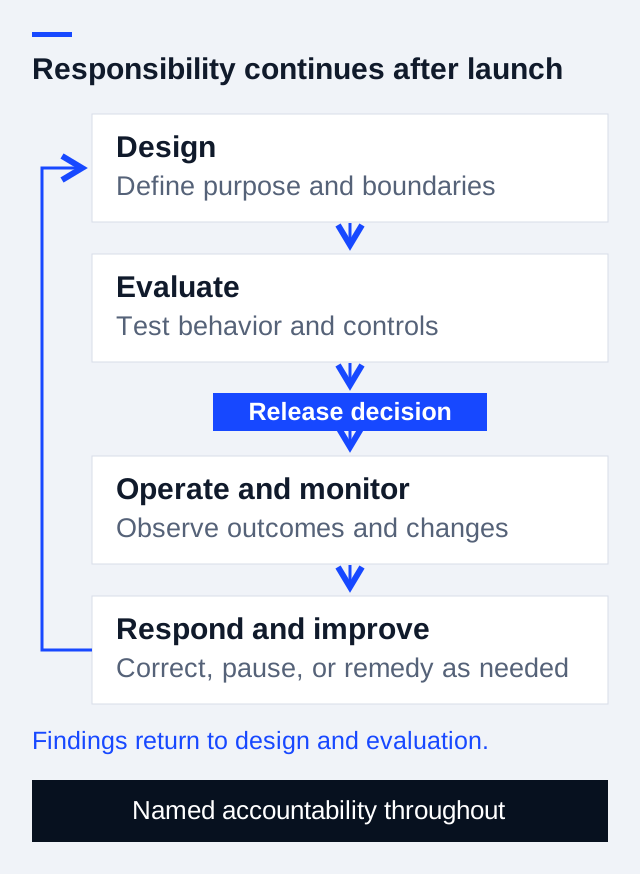
Launch starts an ongoing obligation to respond
A system's operating conditions do not remain fixed. Models are updated, sources change, permissions evolve, and users discover new ways to apply a capability. A workflow approved for summarization may gradually be used to justify decisions that its evaluation never covered.
The operating model needs to recognize such changes and determine when they require renewed assessment. Version records should connect deployed behavior to relevant models, instructions, data sources, tools, and controls. Change review can then consider what has altered, which earlier evidence remains applicable, and what must be reevaluated.
ISO describes ISO/IEC 42001 as a management-system standard for establishing, implementing, maintaining, and continually improving AI management. Its public guidance includes responsibilities, risk management, lifecycle controls, performance evaluation, and monitoring. It also distinguishes the standard from laws and regulations. This supports a continuing management discipline rather than treating approval as a one-time event. ISO/IEC 42001 explained
In practice, a monitoring signal needs someone able to respond. If complaints are repeatedly being closed incorrectly, the organization may need to disable that action, preserve the relevant evidence, identify affected cases, and arrange correction. Technical recovery and remedy for affected people are connected but distinct tasks. Restoring the software does not necessarily resolve the consequences already produced.
The ability to pause or roll back also has to fit the service. Removing an automated capability may shift work to people or disrupt a process on which customers depend. A responsible fallback needs capacity, ownership, and a plan for cases already in progress. Reverting a model version cannot undo every action taken while it was running.
Incident review should lead to changes in the relevant part of the organization: an access boundary, a data source, a workflow objective, a release criterion, or a provider arrangement. The lesson is incomplete if it remains in a report while the same conditions continue.
Policies, standards, and committees can support all of this work. Their value is realized when they change design choices, allocate usable authority, and cause the organization to act on evidence. They do not guarantee that harm will never occur.
Responsible AI is sustained through the organization's capacity to prevent avoidable problems, recognize the limits of its evidence, and respond effectively when behavior or circumstances change. That capacity belongs in the same operating model that produces the business outcome. It has to be built, resourced, and maintained with the system itself.
Sources
- NIST — AI Risk Management Framework 1.0, Core. 2023. Voluntary risk-management framework. NIST identifies version 1.0 as under revision on its current framework page, checked September 2026.
- OECD — Due Diligence Guidance for Responsible AI. February 2026. Guidance connecting responsible business conduct and the AI Principles to identifying, addressing, and tracking adverse impacts.
- OECD — AI Principles. Updated 2024; current official guidance checked September 2026. Intergovernmental recommendations on trustworthy AI, including transparency and accountability.
- ISO — ISO/IEC 42001 explained. Official public explanation of the AI management-system standard, consulted September 2026. This article uses that public explanation rather than reproducing the standard's requirements in detail.
These sources provide normative guidance and management standards, not empirical proof that a particular deployment is responsible or a determination of its legal compliance. The organizational conclusions are Normatic's interpretation. The complaints-handling example is illustrative and does not represent a client engagement or measured result.